
The sanctity of private property ownership intersects with the complex web of familial obligations in ways that can confound even the most legally sophisticated homeowner. In New York's intricate legal landscape, the distinction between a family member who possesses legitimate occupancy rights and one who remains merely a licensee subject to removal can determine the difference between months of costly litigation and swift resolution of property disputes.
The evolution of New York jurisprudence has witnessed a dramatic pendulum swing from broad equitable protection for family occupants to strict statutory construction that prioritizes property rights. Understanding these legal nuances is not merely academic: it represents the foundation upon which homeowners must build their approach to family occupancy disputes, ensuring both compliance with the law and protection of their fundamental property interests.
The Foundation: Entry Circumstances and Initial Permission
The genesis of any family occupancy arrangement lies in the circumstances surrounding the initial entry onto the property. This foundational moment often determines the entire legal framework that will govern the relationship between property owner and family occupant.
When a family member enters your private residence, the law scrutinizes whether this entry occurred with your explicit or implied permission. Consensual entry, even informal in nature, establishes the baseline for a lawful occupancy arrangement. However, the critical distinction emerges between permission granted for temporary refuge and permission that contemplates long-term residency with autonomous control over living space.

The legal significance of entry circumstances cannot be overstated. A family member who arrives during a personal crisis with your compassionate consent occupies fundamentally different legal ground than one who establishes residence through a deliberate arrangement involving household contributions or rent payments. The courts examine not merely the fact of permission, but the scope and nature of that permission as understood by both parties at the time of entry.
Consider the practical implications: if your adult child returns home temporarily following job loss, the legal analysis differs markedly from a scenario where your sibling moves in with the understanding that they will contribute to household expenses and maintain their own living space. The law requires courts to examine the totality of circumstances surrounding entry, including verbal discussions, written communications, and conduct that might indicate the intended scope of the arrangement.
The Nexus of Relationship and Legal Obligation
New York's modern approach to family occupancy disputes has crystallized around a fundamental principle: the existence or absence of a statutory support obligation serves as the primary determinant of enhanced occupancy protections. This represents a decisive departure from earlier jurisprudence that recognized broad familial exceptions to standard landlord-tenant procedures.
The contemporary legal framework, established through cases like Heckman v. Heckman and reinforced in Syed A.H. v. A.S., demands rigorous analysis of whether the property owner bears a legal duty to support the family occupant. Such obligations typically arise through marriage, parent-minor child relationships, or court-ordered support arrangements. The absence of these statutory support duties generally relegates family occupants to licensee status, regardless of emotional bonds or practical family dynamics.
This legal evolution reflects judicial recognition that adult family relationships, while emotionally significant, do not automatically create property interests that can circumvent standard eviction procedures. The law distinguishes sharply between moral obligations: such as caring for elderly parents or supporting struggling siblings: and legal obligations that create enforceable rights to continued occupancy.
Financial Arrangements: The Rent Payment Analysis
The presence or absence of rent payments, and more critically, the property owner's acceptance of such payments, can fundamentally alter the legal characterization of family occupancy arrangements. However, this analysis proves more nuanced than simple recognition of payment exchanges.
Courts examine whether rent payments are regular, accepted as a matter of course, and treated as consideration for occupancy rights rather than mere contributions to household expenses. Occasional financial contributions toward utilities, groceries, or maintenance typically do not elevate a family member's status from licensee to tenant. The legal system requires evidence of a deliberate landlord-tenant relationship characterized by mutual understanding regarding rent, occupancy terms, and the creation of a leasehold interest.

The temporal aspect of rent payments carries particular weight in this analysis. Consistent monthly payments accepted over an extended period suggest the parties' intent to create a formal tenancy arrangement. Conversely, sporadic contributions or payments characterized as "help with expenses" lean toward maintenance of licensee status. Property owners must exercise careful judgment in how they characterize and accept financial contributions from family occupants, as these decisions can inadvertently create tenancy relationships with their attendant procedural protections.
The Significance of Written Versus Informal Agreements
The distinction between documented arrangements and informal family understandings assumes critical importance in determining legal status and available remedies. While New York law does not require written agreements for all tenancy relationships, the absence of documentation often supports licensee characterization, particularly in family contexts.
Written agreements that clearly delineate occupancy terms, financial obligations, and termination procedures provide valuable clarity for all parties involved. Such documentation demonstrates the parties' intent regarding the nature of the relationship and can prevent future disputes about the scope of occupancy rights. However, the mere absence of written documentation does not automatically preclude tenant status if other factors support such classification.
The courts examine informal family arrangements through the lens of reasonable expectations and conduct. Long-term occupancy arrangements accompanied by regular financial contributions and autonomous control over living space may support tenant characterization even without formal documentation. Conversely, casual arrangements allowing family members to "stay until they get back on their feet" typically maintain licensee status regardless of duration.
Control and Exclusivity: The Possession Analysis
The degree of control exercised over the occupied space represents another crucial factor in determining legal status. This analysis examines whether the family occupant possesses exclusive dominion over specific areas of the property or maintains shared use consistent with family household dynamics.
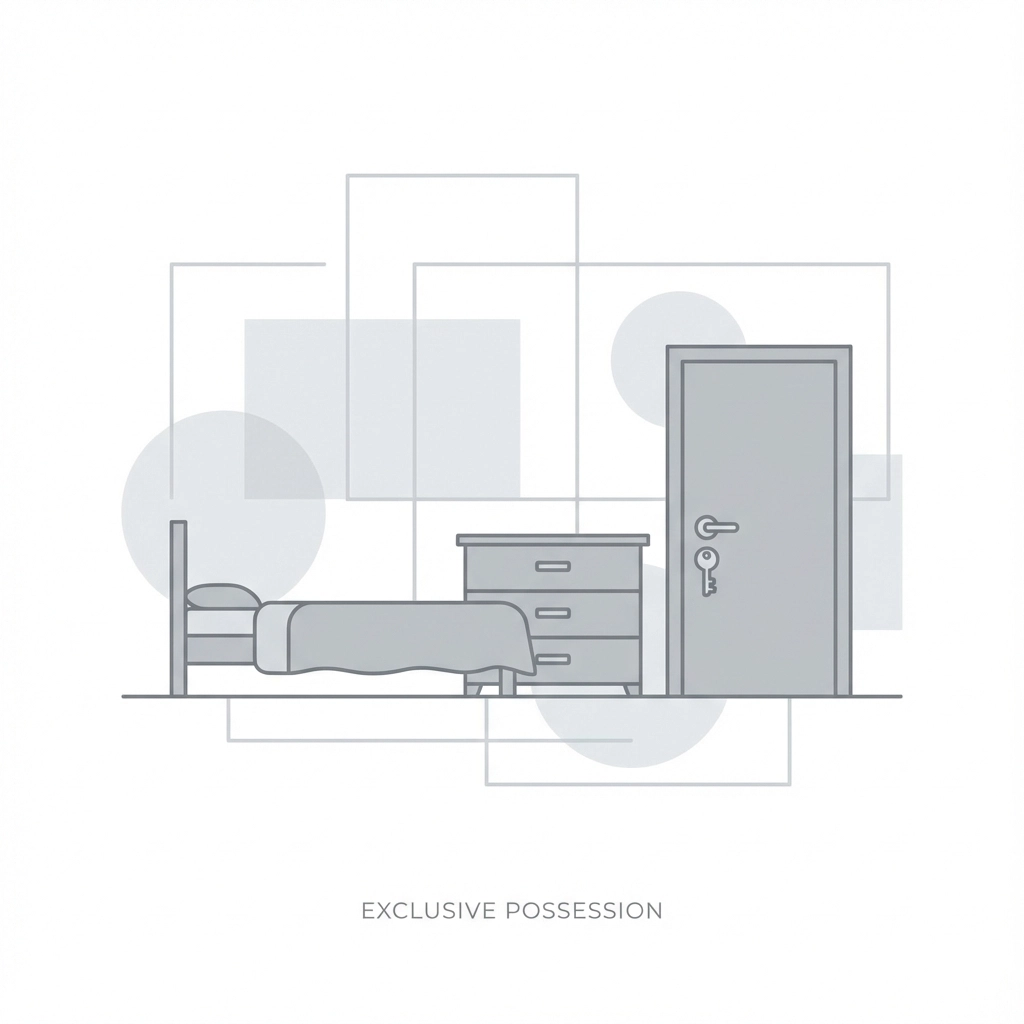
True exclusive possession, voluntarily granted by the property owner, can support tenant characterization. This might involve providing a family member with their own keys, allowing them to restrict others' access to their living space, or treating specific areas as exclusively theirs. However, unilateral assumption of exclusive control without the property owner's consent does not create tenancy rights: it typically constitutes a violation of licensee terms.
The law recognizes that family living arrangements often involve shared common areas while maintaining private bedrooms or spaces. The critical question becomes whether the property owner intended to grant exclusive possession rights or merely permitted use within the broader family household context. This distinction carries significant procedural implications, as tenants enjoy enhanced notice requirements and procedural protections unavailable to licensees.
Duration, Intent, and the Question of Permanence
The intended duration of occupancy arrangements influences legal characterization, though courts resist mechanistic applications of time-based tests. Long-term occupancy alone does not automatically create tenant status, nor does intended temporary occupancy preclude such classification if other factors support it.
The analysis focuses on the parties' mutual understanding regarding the arrangement's permanence and the circumstances that might trigger termination. Arrangements contemplating indefinite occupancy subject only to the property owner's revocable permission typically maintain licensee characterization. Conversely, arrangements establishing fixed terms or requiring specific termination procedures lean toward tenant status.
Courts also examine whether the arrangement evolved over time from temporary accommodation to more permanent residence. Family circumstances change, and what begins as temporary assistance may develop into long-term housing arrangements with different legal implications. Property owners must remain cognizant of how evolving circumstances might alter the legal characterization of occupancy arrangements.
Special Legal Statuses and Enhanced Protections
Certain family relationships carry special legal protections that override standard landlord-tenant procedures. Spousal relationships represent the most significant exception, as courts generally require divorce proceedings rather than landlord-tenant actions to resolve marital property disputes. Similarly, parent-minor child relationships involve support obligations that preclude standard eviction procedures.
The courts also recognize succession rights in certain contexts, particularly regarding rent-regulated apartments where family members may inherit tenancy rights following the original tenant's death or departure. However, these protections typically do not extend to ownership situations involving private houses.
Recent jurisprudence has narrowed the scope of special family protections, rejecting broad theories that treated extended family relationships as automatically immune from standard property procedures. The current legal framework requires specific statutory bases for enhanced protection rather than relying on general familial relationship theories.
Practical Guidance: Determining Status and Next Steps
Property owners confronting family occupancy disputes must approach the situation methodically, beginning with careful analysis of the factors outlined above. Document the circumstances surrounding initial entry, any financial arrangements, the scope of permission granted, and the intended duration of occupancy. Gather evidence regarding exclusive possession, written communications, and any changes in the arrangement over time.
The modern legal framework provides clear guidance: absent specific statutory support obligations, family occupants typically qualify as licensees subject to ten-day termination notice under RPAPL 713(7). However, the procedural requirements demand precision, and property owners must avoid self-help remedies that could complicate legal proceedings.
When family occupancy situations require legal intervention, the expedited summary proceeding courts offer efficient resolution mechanisms that previously were unavailable. However, the pleadings must meticulously address the absence of support obligations and clearly establish the licensee relationship to avoid jurisdictional challenges.
The path forward requires balancing family relationships with property rights protection. While the law acknowledges the emotional complexity of family eviction situations, current jurisprudence establishes that property rights, absent statutory support mandates, take precedence over preservation of adult familial cohabitation arrangements.
Securing Professional Guidance for Complex Family Property Disputes
Family occupancy disputes demand sophisticated legal analysis that accounts for the nuanced interplay between property law, family relationships, and procedural requirements. The stakes are significant: improper characterization of legal status can result in costly delays, jurisdictional challenges, and exposure to procedural violations that undermine otherwise legitimate claims.
Get TOLF on your side! The Ottley Law Firm, PC (TOLFPC) brings comprehensive expertise to family property disputes, ensuring that homeowners navigate these complex legal waters with confidence and precision. Our approach combines thorough legal analysis with practical solutions that protect both property interests and family relationships where possible.
The legal landscape continues to evolve, and property owners benefit from professional guidance that stays current with developing jurisprudence while providing clear, actionable advice for immediate situations. Whether you face an urgent family occupancy crisis or seek to establish clear parameters for future arrangements, experienced legal counsel ensures that your property rights receive full protection under New York law.
For comprehensive legal guidance on family occupancy matters and property protection strategies, contact The Ottley Law Firm, PC to schedule a consultation that addresses your specific circumstances and objectives.
By Roland G. Ottley, Esq.
The Ottley Law Firm, PC






0 Comments