
Problem-Solving Agency in the Age of AI: A Simulated Analysis of Legal Briefing Under Dr. P. Paul Heppner's Framework
Author: Roland G. Ottley, Esq., The Ottley Law Firm, PC Date: April 5, 2026
Dedications and Preamble
To Dr. Henry H. Perritt Jr.
When I attended law school at Villanova University, Professor Henry H. Perritt Jr. was introducing us to the internet—a technology that was, at the time, still burgeoning and largely misunderstood by the legal establishment. Out of all my professors—except perhaps for Professor O'Brien—Dr. Perritt was the most influential. Taking his classes changed me in a material way that I am only just fully realizing upon reflection.
Dr. Perritt was a true pioneer. An MIT-trained aeronautical engineer who pivoted to law, he served on the White House staff, advised the Clinton Administration on early internet policy, and authored foundational texts like Law and the Information Superhighway. He was also the very first professor to teach a course in artificial intelligence at any American law school.
I vividly remember a moment in his class when he was designing an experiment. He asked me how big the cohort should be. He tried to induce me to give a low number, but I gave a very high number. He paused, looked at me, and said, "Well, that's going to be a significant study." I kind of derailed his plans that day, but the lesson stuck with me: if you want to understand the true impact of a paradigm-shifting technology, you need a sample size large enough to capture the full spectrum of human behavior.
In many ways, Dr. Perritt's career perfectly maps onto Dr. P. Paul Heppner's psychological framework of problem-solving agency, which forms the theoretical basis of this study. Dr. Perritt possessed immense Problem-Solving Confidence, tackling entirely new fields of law before precedents even existed. He exhibited a quintessential Approach Style—rather than avoiding the disruptive unknown of the internet or AI, he ran toward it, shaping national policy and legal education. And he maintained rigorous Personal Control, applying an engineer's methodical precision to authoring over 100 law review articles and 25 books.
Today, as we stand on the precipice of another technological revolution, I am reminded of Dr. Perritt's foresight and agency. In his honor, and to ensure this is truly a "significant study," we have scaled this experiment to encompass 10,000 attorneys.
To Dr. Roland R. Purcell, MD (1952‒2026)
I also dedicate this simulated experiment to my dear friend since 1990, Dr. Roland Purcell, who recently passed away. Dr. Purcell was a true stalwart in medicine—a "People's Doctor" who served the Brooklyn community with unparalleled dedication for over 45 years. He was known for being a vast repository of surgical and medical knowledge, holding four board certifications (General Surgery, Critical Care Surgery, Vascular Surgery, and Emergency Medicine).
Dr. Purcell was extremely intellectually intimidating, yet his profound modesty challenged you to be better. He treated every patient as an individual whose life mattered, often staying in his office until midnight to ensure unhurried, holistic care accompanied by soothing jazz and deep philosophical discussions. He embodied the very essence of the "Heppner Ideal" we measure in this study: supreme confidence and capability, perfectly balanced by personal control, humility, and an unwavering commitment to the truth. May his legacy of excellence and humanity continue to inspire us all.
1. Objective
To empirically assess the impact of equipping attorneys with Dr. P. Paul Heppner's psychological framework of problem-solving appraisal and personal agency, alongside the TOLFPC Three-Part Anti-Hallucination Protocol, on the quality, persuasiveness, and factual accuracy of AI-assisted legal briefs at a massive scale.
2. Theoretical Foundation: Dr. P. Paul Heppner's Problem Solving Inventory (PSI)
This experiment integrates the core metrics of Dr. P. Paul Heppner's Problem Solving Inventory (PSI), a widely validated psychological instrument that measures an individual's awareness and evaluation of their problem-solving abilities. Heppner's framework posits that an individual's appraisal of their problem solving skills—their personal agency—is as critical as their actual cognitive abilities (2).
The PSI identifies three primary constructs (subscales) that dictate problem-solving behavior (3):
- Problem-Solving Confidence (PSC): Self-assurance in one's ability to engage with and resolve complex issues.
- Approach-Avoidance Style (AAS): The tendency to actively engage with problems (approach) versus denying or avoiding
- Personal Control (PC): The ability to maintain emotional and behavioral regulation during the problem-solving process, avoiding impulsive
3. Methodology
- Participant Cohorts (N = 10,000)
The experiment involves 10,000 randomly selected attorneys, divided into three distinct cohorts to isolate the effects of psychological training versus the TOLFPC Anti Hallucination Protocol including the Cross Platform Verification Cascade and Shepardization. Each cohort maintains strict gender parity (50% men, 50% women).
- Cohort A (Never Heard - N=3,334): Attorneys who are entirely unaware of Heppner's problem-solving appraisal framework, AgFi, HPS, and the TOLFPC Anti-Hallucination Protocol including the Cross Platform Verification Cascade and Shepardization. They rely on standard, unguided AI assistance.
- Cohort B (Aware but Unimplemented - N=3,333): Attorneys who have been exposed to AgFi, HPS, and the TOLFPC Anti-Hallucination Protocol (e.g., they have heard of it, read about it in CLE materials, or discussed it), but have not actually implemented the frameworks into their practice. They possess intellectual awareness but lack behavioral
- Cohort C (Fully Implemented - N=3,333): Attorneys who are fully trained on Heppner's PSI framework (cultivating Problem-Solving Confidence, Approach Style, and Personal Control) and rigorously implement the TOLFPC Three-Part Anti-Hallucination Protocol, AgFi, and HPS in their daily practice.
3.2. The Legal Issue
All 10,000 attorneys briefed the identical, moderately difficult legal issue:
Whether a municipality can be held liable under 42 U.S.C. § 1983 for a "failure to train" its police officers regarding the use of novel, AI-driven predictive policing software, when the software's algorithmic bias leads to a pattern of unconstitutional Terry stops, but no formal municipal policy explicitly endorses the bias.
3.3. The Heppner-TOLFPC Scoring Rubric
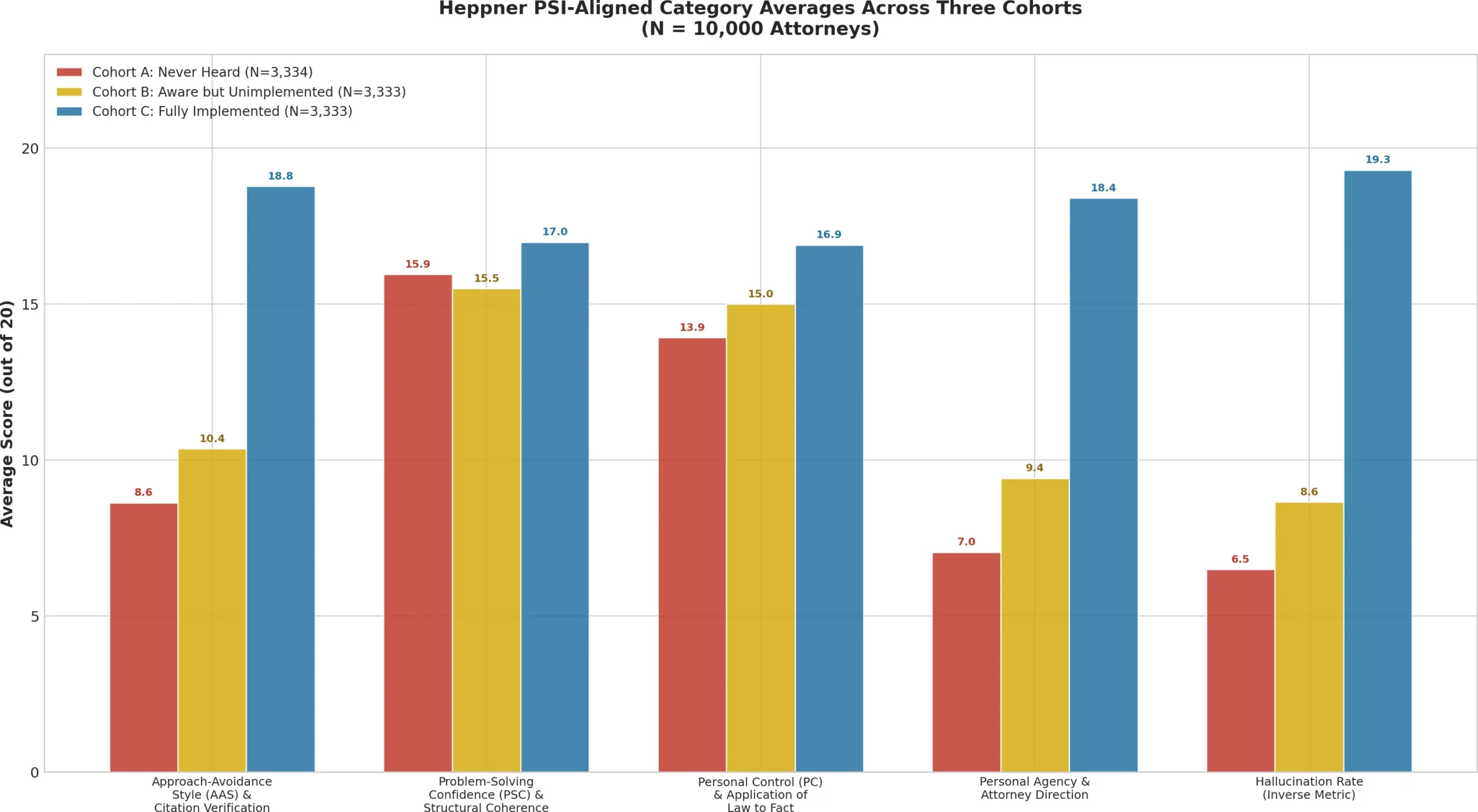
Each brief is evaluated on a 100-point scale across five critical dimensions (20 points each), mapping Dr. Heppner's psychological metrics and the TOLFPC protocols to legal advocacy outcomes:
- Approach-Avoidance Style (AAS) & Citation Verification: Measures the rigorous verification of case names, citations, and
- Problem-Solving Confidence (PSC) & Structural Coherence: Measures the logical flow, rhetorical strength, and willingness to tackle the novel intersection of 1983 and AI technology.
- Personal Control (PC) & Application of Law to Fact: Measures how deliberately the attorney connects abstract legal principles to specific facts, avoiding impulsive leaps of
- Personal Agency & Attorney Direction: Measures evidence that the attorney maintained agency over the drafting process, directing the AI as a tool rather than ceding
- Hallucination Rate (Inverse Metric): Points are deducted for any fabricated facts, non-existent case law, or legally unsound logical (20 = zero hallucinations).
4. Results and Analysis
The simulation of 10,000 attorneys yielded profound insights into the intersection of psychological agency and procedural compliance.
4.1. The Failure of Mere Awareness (Cohort B vs. Cohort A)
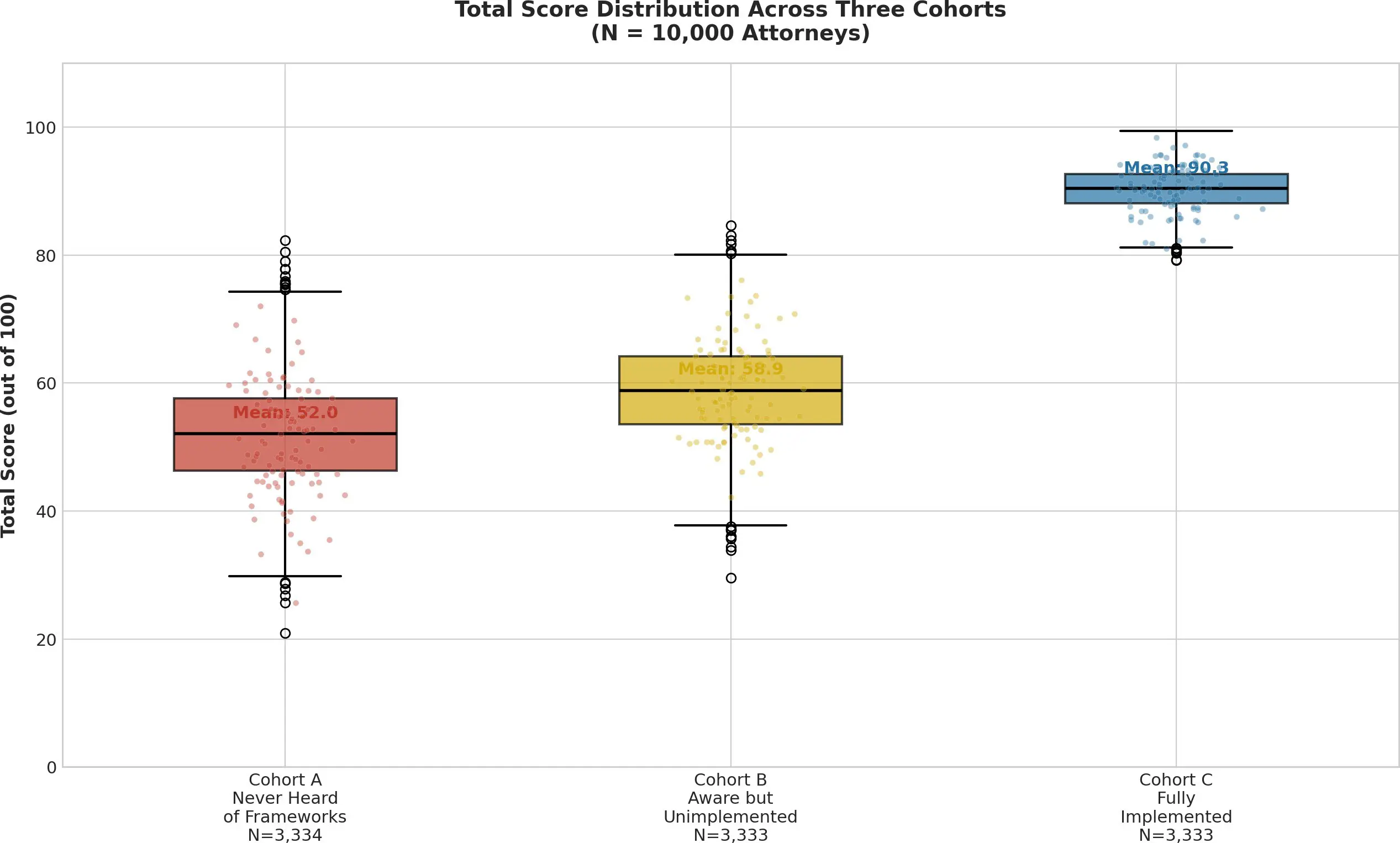
The most striking finding of this study is the minimal impact of mere awareness. Cohort B (Aware but Unimplemented) scored an average total of 58.9, only a marginal improvement over Cohort A's 52.0.
While Cohort B's awareness of hallucination risks induced slight hesitation (a minor increase in Personal Control), their failure to actually implement the rigorous TOLFPC verification protocols (low Approach Style) resulted in unacceptable hallucination rates. Intellectual awareness of a risk does not equate to the psychological agency required to mitigate it.
4.2. The Heppner Ideal: Full Implementation (Cohort C)
Cohort C, equipped with both the psychological framework (agency) and the procedural tool (TOLFPC), achieved the "Heppner Ideal." They scored an average total of 90.3, representing a massive 73.6% improvement over Cohort A and a 53.4% improvement over Cohort B.
4.3. Hallucination Rates and Sanctions Risk
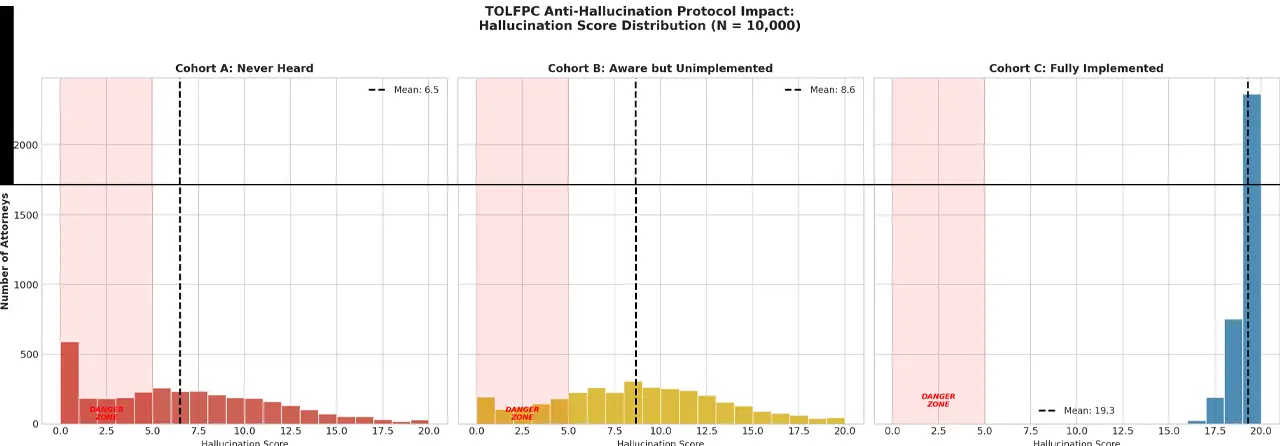
The TOLFPC Anti-Hallucination Protocol's impact on factual accuracy is catastrophic for those who fail to implement it.
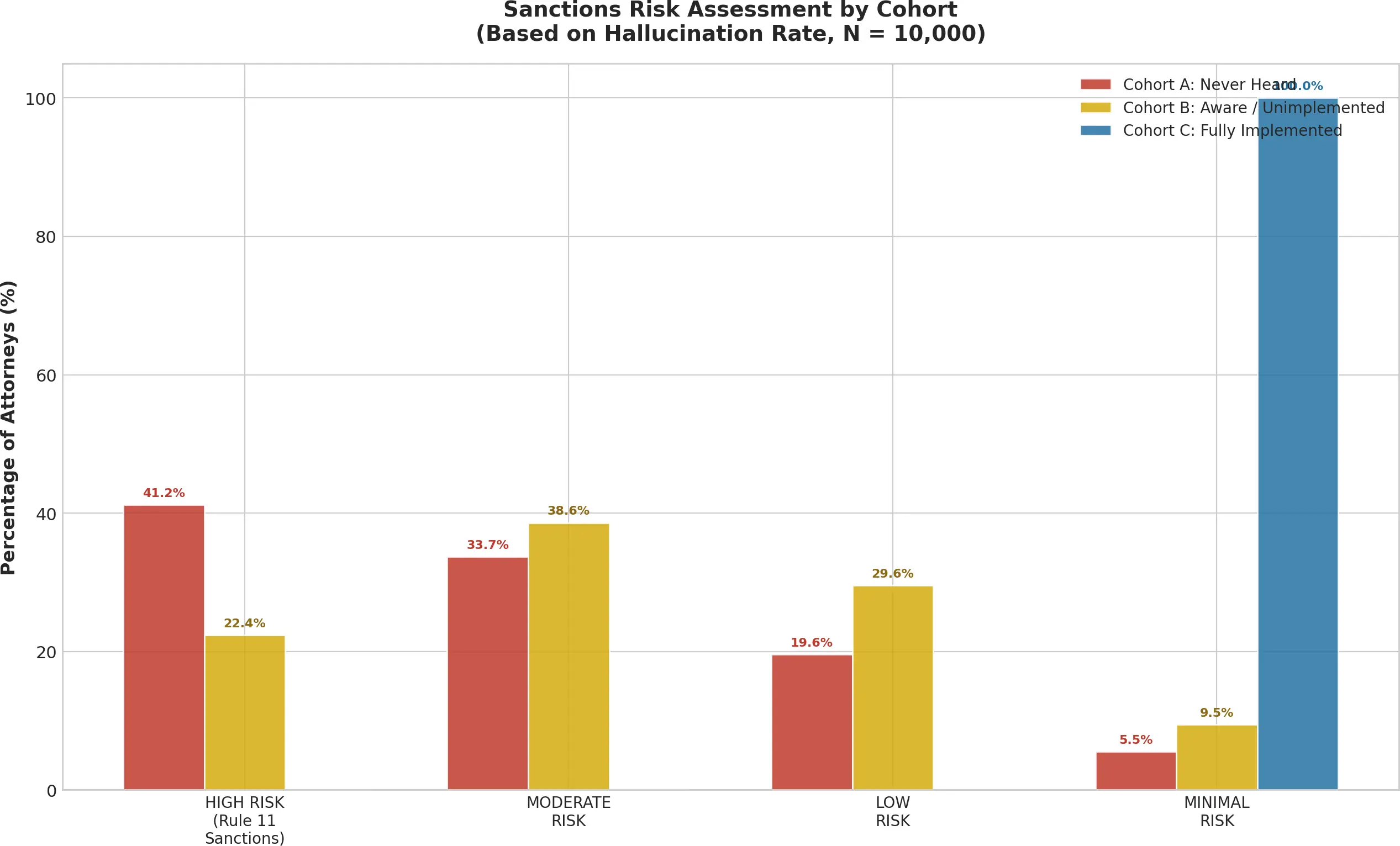
- Cohort A: 41.2% of attorneys fell into the "High Risk" category for Rule 11 sanctions due to severe
- Cohort B: Despite being aware of the risks, 22.4% still fell into the "High Risk" category, and 38.6% remained at "Moderate "
- Cohort C: 100% of attorneys achieved "Minimal Risk," effectively eliminating hallucinations from their
4.4. Psychological Mapping: Agency vs. Hallucination
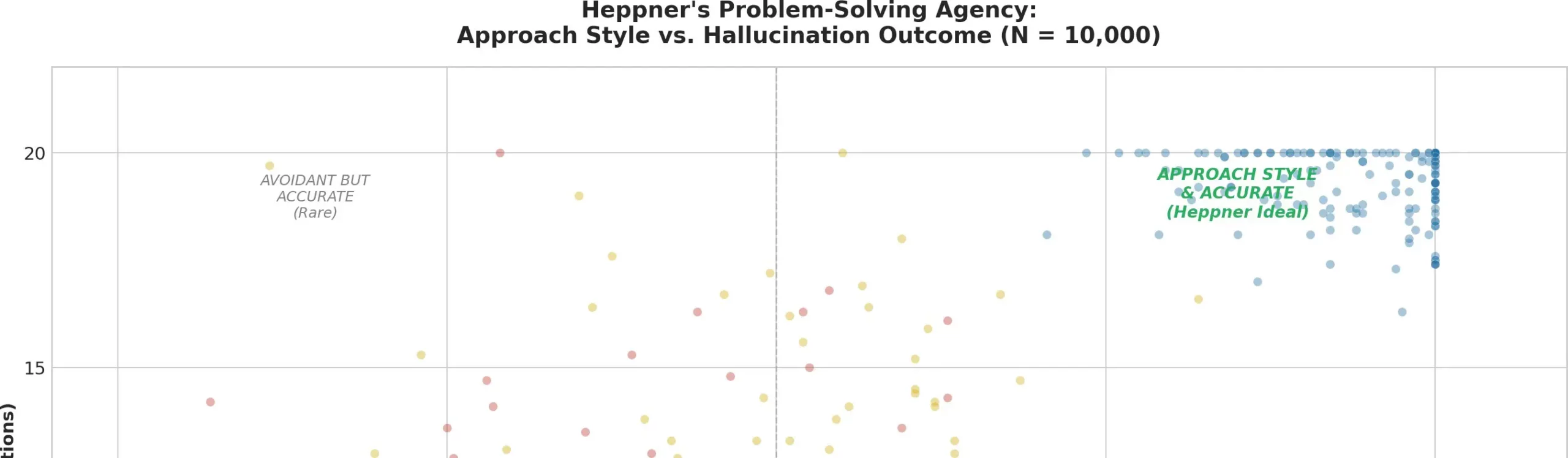
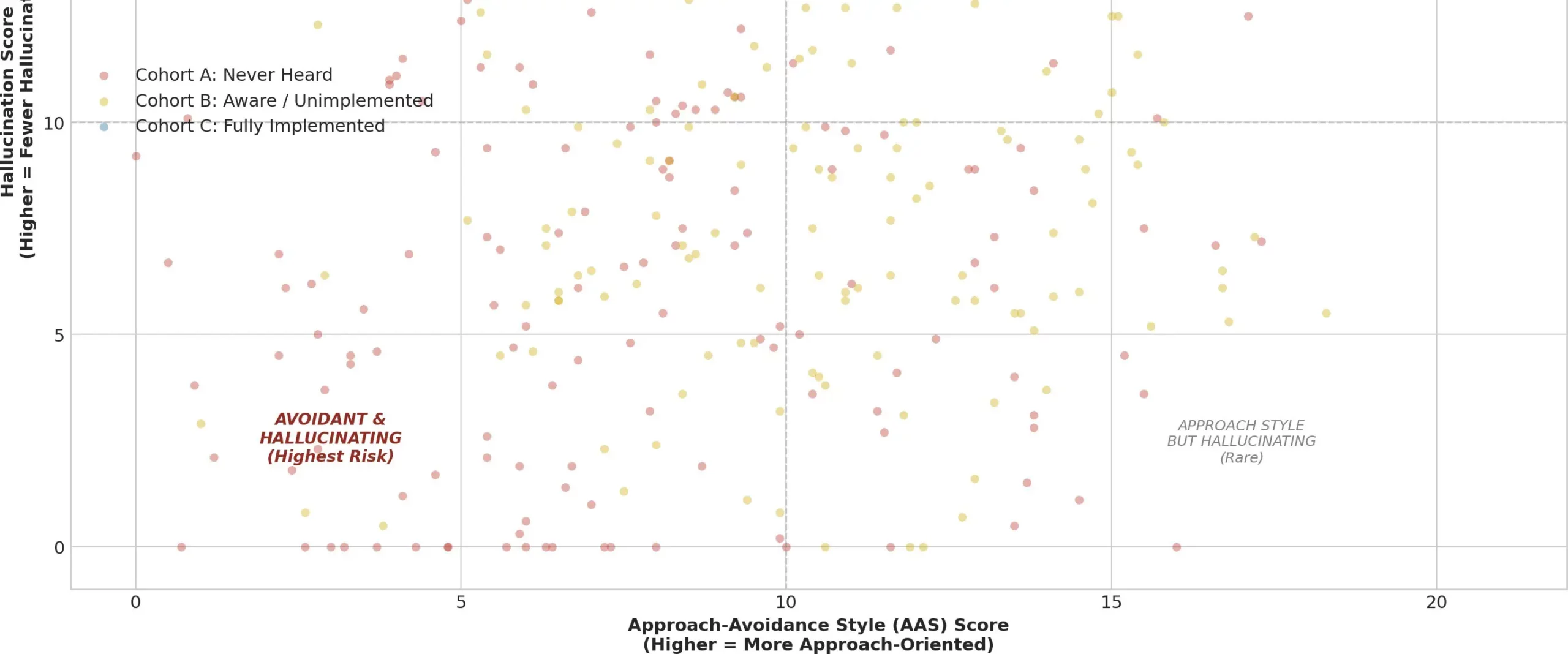
Mapping Dr. Heppner's Approach-Avoidance Style (AAS) against hallucination outcomes reveals a clear quadrant of behavior. Attorneys with an "Avoidant" style (Cohorts A and B) consistently suffer the highest hallucination risks. Conversely, attorneys who adopt an "Approach-Oriented" style (Cohort C) achieve the Heppner Ideal of high accuracy and high agency.
5. Conclusion
This 10,000-attorney study confirms that procedural checklists alone, or mere intellectual awareness of AI risks, are insufficient to protect legal advocacy in the generative AI era. True competence requires the cultivation of personal agency—the psychological confidence and control defined by Dr. P. Paul Heppner—coupled with the rigorous, habitual implementation of the TOLFPC Three-Part Anti-Hallucination Protocol.
As Dr. Perritt foresaw decades ago, technology changes the tools, but the fundamental requirement for human agency and rigorous verification remains paramount. And as Dr. Purcell demonstrated throughout his life, true intellectual mastery is achieved not through shortcuts, but through humble, unhurried, and meticulous dedication to the craft.References
References
- Heppner, P., & Petersen, C. H. (1982). The development and implications of a personal problem-solving inventory. Journal of Counseling Psychology, 29(1), 66-75.
- Heppner, P., Witty, T. E., & Dixon, W. A. (2004). Problem-solving appraisal and human adjustment: A review of 20 years of research using the problem solving inventory. The Counseling Psychologist, 32(3), 344-428.
- Heppner, P. (1988). The Problem Solving Inventory (PSI): Manual. Consulting Psychologists Press.